Street Name Collages
For History Festival 2026, we are diving into Street Names and their origins.
Often, we don’t give our street names much thought, seeing them every day, using them for navigation and invitation.
To tell these stories, we have worked with the talented year 11 art students at Immanuel College and artist Elle Dawson Scott to create a series of collages illuding to these street name origins.
Locations
Read about origins of the Street Names and how the students chose to represent them
Alkira St, Glenelg North
by Zuwena
Much of Novar Gardens was developed during the mid-20th century as Adelaide expanded toward the coast. Former farmland and open land were gradually subdivided into residential streets like Alkira Street. Today, the street reflects this suburban history with modest homes, quiet roads, and a strong sense community.
The word “Alkira” is believed to be an Aboriginal word from the Arrente tribe in the Northen Territory and the Kulin Nation in Victoria, meaning bright or sunny place, reflecting the open skies and warm light of the land. Alkira Street sits within the suburb of Novar Gardens, an area that was originally part of the traditional lands of the Kaurna people.
In this design, as the artist I tried to tie into the deeper connection to first nation’s history behind the name. The collage includes photographs of the indigenous nations the word relates to, contemporary aboriginal dot painting designs and other materials/designs.
Aroona Street, Glenelg North
by Sienna
Aroona is an aboriginal word that means place of water or place of refreshing. In my artwork this is symbolised by a frog and filled with pictures that made me feel calm and relaxed. I found it meditative to reflect on the meaning of the word by using blue tones to portray the ocean and the quiet and calm of the water.
Attunga St, Glenelg North
by Olivia
Attunga is an aboriginal word meaning high place - most commonly identified as coming from the Wiradjuri language
My vision was for the collage was to look like Outback Australia and to show themes of connection to land and how Australia is home to everyone. I am hoping to connect you, the viewer, with the art, and see the connection between people and animals and the land. I connected the name Attunga by stacking yellow and orange images to represent both the colour of the outback and mountains. Additionally, the starry sky emphasises the theme of a high place and adds contrast.
Berrima Street, Glenelg North
by Luca
Berrima Street takes its name from an Aboriginal word that is believed to mean “going southward” or “black swan”. Berrima is also a small town located in the Southand Highlands area of NSW, and the word comes from the language of the traditional custodians of that area, the Dharawal people.
To represent this meaning, I have included 2 black swans in the foreground of the artwork with the Southern Cross positioned over them - on top of a map of Glenelg, to symbolise the south. I also chose to incorporate the Southern Cross because of its significance to Aboriginal people. The Southern Cross was used as a navigation tool, seasonal indicator and a foundational element in cosmology, often representing ancestral stories, cultural law and connection to country.
You will also find spiral shapes in the water, as, like the black swans, spirals also symbolise growth and transformation.
Iluka Street, Glenelg North
by Marridia
Iluka is an Aboriginal name that originates from NSW Dhanggati mob, meaning, near the sea.
During the time the area was being developed with War Service Homes being built, the name “Iluka” was taken from an Aboriginal dictionary, signifying a connection to coastal, natural beauty.
My collage has a layer of meaning behind Iluka Street in Glenelg North, bringing together ideas of place, language, and history.
On one side of my collage, I've included building of war homes and significant places in Glenelg and from NSW.
On the other, I have created a dot painting that represents the coastline from Glenelg to North Haven and down to Port Noarlunga, and in the bottom and top corners, I have added strips of paper and added watercolours on top, which represent the clearance river, a special place for the Dhanggati tribe connecting to the word “Iluka.” The dots throughout the work represent Aboriginal people and their ongoing connection to land and water.
My artwork shows how an Aboriginal word can represent many meanings and exist within modern places, even when removed from its original context – and showing how a simple street name can hold deeper cultural meanings and histories.

Ulinga Street, Glenelg North
by Phoebe
The word Ulinga derives from an Aboriginal phrase meaning “to fly” and represents growth and progress.
I incorporated these meanings into my collage by using flowers at the bottom to symbolize growth and birds to symbolize flight. I also created the background from maps and information about the local area of Novar Gardens, using black and white to allowing the colour of the flowers and birds and the meaning of ‘Ulinga’ to shine through.
My choice of birds both photographic and illustrated along with the strong bright flowers are gathered to create a “scarp collage” look.
Ulinga Street, Glenelg North
by Shia
When researching the name Ulinga, I discovered it to be the aboriginal word for fly high or soaring.
With this meaning in mind, I have focused my collage on the animals and machines that fly in the sky. You will find Native birds of the Adelaide region - the Kookaburra, Rainbow Lorikeet, and the New Holland Honeyeater, alongside early aeroplanes and jets.
I decided to use birds to show the animals who live for the sky, giving meaning to the artwork by showing people that the sky has no limit and that they can go anywhere in life if they try. I chose the aeroplanes and jets, to show that differences do not matter in life. I wanted the aeroplanes and jets to show that u can be old, young, rich, poor, fast and slow, as long as you follow your path that you’ll get to your destination in the end.
Wongala Ave, Glenelg North
by Shia
Wongala Ave is the aboriginal word for boomerang. This word originates from Queensland around the Mackay area. The word comes from the Yuwibara tribe, who are the traditional owner of the Mackay area.
For this collage, I have chosen a range of pictures that represent the word Wongala, including the nature that are located in the Yuwibara region, maps of the street’s location, and objects that share the same name. The centrepiece of the artwork is a boomerang, which I painted on a separate piece of paper to include as a collaged piece. In the boomerang you will find animals native to the Mackay region including the Yuwibara tribe’s totem - the Black tailed Kangaroo. In background of the artwork, you will find symbols for kangaroo tracks and campsites, to represent the street and houses in Wongala street as well as a train track to show the journey that the word Wongala has made, starting in Queensland and landing in South Australia.
Audrey Street, Novar Gardens
by Manami
Named after Audrey Morphett Cummins, the great-grand daughter of Sir John Morphett, due to the close proximity to Cummins house where she lived.
Audrey was well known as a community worker, involved in many charitable organisations, as well as a historian who worked closely with her father George Cummins Morphett.
During the lead up to World War II, Morphett began training to instruct civilians in air-raid precautions, in delivering first aid and how to respond in poison gas attacks.
I am an exchange student to Australia from Japan, so in my collage, I put on pictures of Australian animals and trees. When I walked around the area, there was so much greenery and I felt very close to nature when I went to there. I made the animal pictures stand out more by painting almost everything else in blue.
Cummins Street, Novar Gardens
by Riley
Named after George Cummins Morphett who was an Australian politician. He was a member of the south Australian house of assembly and wrote many books one about his grandfather "The Life And Letters Of Sir John Morphett"
I decided to use articles and pictures relating to Cummins Street and Cummins house which is not actually located on Cummins Street but close by Sheoak Ave. Cummins House was occupied by John Morphett and his family and named after his mother’s house in England. I put roses on the bottom of the artwork as there are beautiful rose gardens around Cummins House, and I put a sturt desert pea flower in the centre as John Morphett was part of the South Australian legislative council where he was treasurer.
Sheoak Street, Novar Gardens
by Paige
Named after the native Sheoak trees that were likely found in the local landscape. The Sheoak is often connected to healing, strength, and feminine energy because of its soft, flowing branches and calming presence in nature. The street name reflects ideas of resilience, nurturing, and the natural environment surrounding the tree.
This street that holds special meaning for me as my parents were married at the Cummins house in 2002, a place that adds personal history and emotion to my art. Although my parents later divorced, the memories tied to Sheoak Avenue remain important to me, representing both the joy of their union and the difficulties of family life. Through my artwork, I explore these feelings and the beauty of this unique location.
Violet Court, Novar Garddens
by Sachini
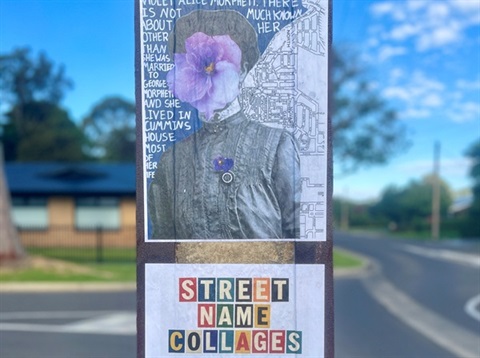
Named after Violet Alice Morphett. There is not much known about Violet other than that she was married to George Morphett and was therefore the daughter in law of John Morphett. She lived in Cummins house for the majority of her life.
To symbolise the lack of information – which is common for women of this generation - I chose to portray Violet with a generic image of a women from the this period of time use a beautiful violet flower for her face - representing the mystery about who she was. I used a map on the side to show the location of the street and added text to again represent what little is known about her and how in history she was reduced to someone’s wife.
Cygnet Street, Novar Gardens
by Grace
Named after the Cygnet, a 239-ton barque (a sailing vessel with 3 or more masts with square sails). It carried many of the surveying staff for the new Colony of South Australia. The Cygnet left on 24 March 1836 and arrived at Kangaroo Island on 11 September 1836 and moved onto Holdfast Bay on 5 November 1836.
Cygnet is also the name for a young swan.
I chose this street as I have always loved the Australian swans and have therefore represented them in my collage, along with a silhouette of The Cygnet approaching land – representing the arrival at Kangaroo Island.
Torn paper with blue watercolour depicts the water. For the swan I used different materials painted black.
While John Morphett did not have strong ties to this particular street, many of the streets in the surrounding area are named after members of his family, and for this reason I decided to include pictures of him in the back of the sky to add interest and further connection to the area.
McLachlan Street, Glenelg North
By India
Connected to the Glenelg Golf Club, this street is named after James “Jimmy” McLachlan, a Scottish golfer who was the club’s first professional from 1928 to 1936. He helped develop golf in the area and is remembered through the Jimmy McLachlan Trophy at the club.
For my artwork, I created a golf course collage featuring two hand painted golf carts. Inspired by this connection, I designed my collage to reflect the area’s golfing heritage, using layered coloured paper and hand painted elements to bring the scene to life.
Harvey Terrace, Glenelg North
by Noa
Named after William Harvey (1896 - 1951). William was a Scotsman, a passionate and popular golfer, golf pro and winner of multiple State Professional Golf Championships in South Australia.
James Melrose Road, Glenelg North / Novar Gardens
by Jonathan
James Melrose Drive is named after Jimmy Melrose, a young Pilot who lived in Glenelg. He was the youngest and only solo pilot to race in the 1934 England- Australia race and came 3rd, he was a hero and was famous in South Australia. He died in 1936 in a fateful plane crash when he was just 22 Years old. . This made me think about how success can also come with risks.
In my artwork, I wanted to show both his achievements and the sad part of his story by using newspaper articles and images to remember him by.
James Melrose Road, Glenelg / Novar Gardens
by Melanie
James “Jimmy” Melrose was a young pilot who lived in Glenelg. He rose to global celebrity being the youngest and only solo pilot in the 1934 England-Australia race. He died in 1936 at the age of 22, in a plane crash over South Melton, Victoria in his own Heston Phoenix plane. I reflected on this tragedy and included the words from a poem that was my grandfather’s favourite called High Flight by John Gillespie Magee Jr. My own grandfather was a pilot and died in a plane crash and I never met him, but I know his favourite poem:
Oh! I have slipped the surly bonds of Earth
And danced the skies on laughter-silvered wings;
Sunward I've climbed, and joined the tumbling mirth
of sun-split clouds,—and done a hundred things
You have not dreamed of—wheeled and soared and swung
High in the sunlit silence. Hov'ring there,
I've chased the shouting wind along, and flung
My eager craft through footless halls of air ....
Up, up the long, delirious, burning blue
I've topped the wind-swept heights with easy grace
Where never lark, or even eagle flew—
And, while with silent lifting mind I've trod
The high untrespassed sanctity of space,
Put out my hand, and touched the face of God.
